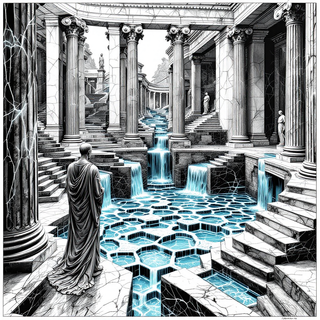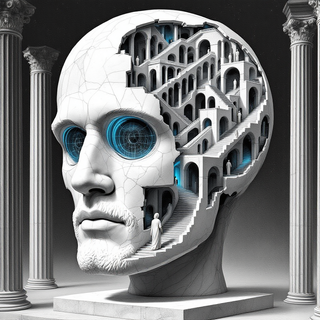
Twenty-four centuries ago, a Greek philosopher described a group of prisoners chained inside a cave, watching shadows flicker on the wall, and mistaking those shadows for reality. The prisoners were not stupid. They were observant, analytical, and socially sophisticated. They developed taxonomies of the shadows. They debated which shadows would appear next. The best shadow-predictors earned status within the group. They had built an entire civilization of interpretation around projections -- and they had no reason to suspect the projections were not the thing itself.
Plato wrote this in Book VII of The Republic as an allegory for the human relationship to knowledge. The shadows were opinion. The fire was culture. The sunlight outside the cave was direct understanding of the underlying reality producing the opinions. The allegory has been taught in undergraduate philosophy courses for centuries, usually as a quaint metaphor about the importance of education.
It was never a metaphor. It was a diagnostic framework.
The cave is still the cave. The chains are still the chains. The shadows are now Instagram health influencers, supplement marketing copy, psychiatric diagnoses handed out like identity badges, and algorithmic feeds that curate a reality so personalized it becomes indistinguishable from truth. The prisoners are still watching shadows and building sophisticated interpretive frameworks around them. The only difference is that the shadows now arrive at 60 frames per second, with affiliate links attached.
The reason Plato's Cave endures as the most cited philosophical thought experiment in Western intellectual history has nothing to do with its elegance and everything to do with its accuracy. The allegory describes a failure mode that is hardwired into the human nervous system. The brain defaults to shadow-watching because shadow-watching is metabolically cheap, socially rewarded, and psychologically comfortable. Turning around -- facing the fire, walking toward the light, seeing the objects casting the shadows -- is energetically expensive, socially punishing, and psychologically destabilizing.
The allegory describes, in pre-scientific language, the neurobiological architecture of belief formation, confirmation bias, and cognitive ease. Plato did not have fMRI data. He did not need it. He observed the system from the output side and described its constraints with a precision that twenty-first-century neuroscience has done little to improve upon.
The question has never been whether the cave exists. The question is why almost nobody leaves.
The brain evolved to stay
Evolution builds for survival, not for accuracy.
This distinction explains the entire architecture of human cognition. The brain did not evolve to model reality faithfully. It evolved to model reality usefully -- to generate predictions that keep the organism alive long enough to reproduce. Where accuracy and survival diverge, survival wins every time. The brain that sees a shadow in the grass and assumes it is a predator survives more often than the brain that pauses to gather additional data. The cost of a false positive (unnecessary fear) is metabolically trivial. The cost of a false negative (getting eaten) is absolute.
Cognitive heuristics -- the shortcuts the brain uses to make fast decisions with incomplete information -- are the products of this selection pressure. They are metabolic energy-saving strategies refined across millions of years. They produce fast, good-enough answers at a fraction of the caloric cost of careful analysis. And they are the chains that keep the prisoners facing the wall.
The brain was built for the cave. Leaving it requires overriding hardware that has been under positive selection since the Pleistocene.
The modern shadows
The allegory's original shadows were cultural opinions -- secondhand interpretations of reality passed between citizens who had never investigated the underlying structure of the things they claimed to know about. The mechanism has not changed. The delivery system has scaled.
Health influencers monetize partial truth. A fitness creator with two million followers posts a video claiming that a specific supplement "increases testosterone by 300%." The claim is based on a single rodent study using intraperitoneal injection at doses that would be pharmacologically absurd in humans. The video does not mention the study design. It does not mention the route of administration. It does not mention that the human bioavailability data for the compound shows negligible oral absorption. The video generates four million views, six hundred thousand likes, and a tsunami of affiliate revenue from the supplement link in the bio. The audience now "knows" that this compound increases testosterone. They have watched the shadow and filed it as fact.
The influencer is the prisoner who has become the best shadow-interpreter. Status within the cave accrues to those who describe the shadows most confidently, not to those who question whether the shadows are the right thing to be looking at.
Supplement marketing sells certainty. The $60 billion global supplement industry operates on a business model that requires consumers to believe they need specific products without understanding the mechanisms well enough to evaluate the claims. The marketing language is calibrated for this -- "clinically studied ingredients," "backed by science," "doctor recommended" -- phrases that gesture toward evidence without providing any. The consumer receives a feeling of scientific legitimacy. The feeling substitutes for the understanding. The shadow substitutes for the object.
An entire market exists because most consumers cannot distinguish between a study showing statistical significance at p < 0.05 in a well-designed RCT and a study showing a trend in an underpowered pilot with no blinding and a conflict-of-interest disclosure longer than the methods section. The inability to make this distinction is not a character flaw. It is an education gap that the marketing depends on.
Psychiatric diagnoses become identities. The diagnostic categories in the DSM were designed as clinical tools -- standardized descriptions of symptom clusters intended to facilitate communication between practitioners and guide treatment decisions. Somewhere in the migration from clinical manual to social media content, diagnoses became personality descriptors. "I'm ADHD." "I'm on the spectrum." "I have anxiety." The diagnostic label, which was meant to describe a pattern of neurological variation for the purpose of intervention, becomes a fixed identity that the person builds a social world around.
The label becomes the shadow. The underlying neurochemistry -- the actual dopaminergic configuration, the specific receptor polymorphisms, the tonic-phasic firing patterns that produce the behavior the label was meant to describe -- remains invisible. The person knows their label. They do not know their biology. They have a name for the shadow. They have never seen what casts it.
Algorithmic feeds build personalized caves. Recommendation algorithms optimize for engagement, which means they optimize for confirmation bias at industrial scale. A person who watches three videos about a specific health claim will be served forty more videos reinforcing that claim, each progressively more extreme than the last, because extremity drives engagement and engagement drives revenue. The algorithm constructs a reality tunnel so perfectly calibrated to the user's existing beliefs that deviation feels physically uncomfortable -- like looking at a bright light after years of watching shadows.
The personalized feed is the most efficient cave ever built. It requires no chains. The prisoner stays voluntarily because the shadows have never been so entertaining.
The neuroscience of staying
The brain has at least four distinct mechanisms that keep the organism facing the wall. Each serves a metabolic, social, or psychological function. Together they produce a gravitational field so strong that leaving the cave requires sustained, deliberate, energetically expensive effort.
Enjoying this? Subscribe to Elon Muskular for free.
SubscribeConfirmation bias is a metabolic conservation strategy. Daniel Kahneman's dual-process framework describes two modes of cognitive operation. System 1 is fast, automatic, effortless, and associative. It processes incoming information against existing mental models and produces rapid judgments without conscious deliberation. System 2 is slow, deliberate, effortful, and analytical. It evaluates evidence, weighs competing claims, and revises existing models when the evidence demands it. System 2 is metabolically expensive. The prefrontal cortex -- the brain region most responsible for analytical reasoning, evidence evaluation, and model revision -- consumes glucose at a higher rate per gram of tissue than almost any other neural structure. Sustained System 2 engagement produces measurable cognitive fatigue.
Confirmation bias operates by routing incoming information through System 1 wherever possible. Information that aligns with existing beliefs receives automatic processing -- it "feels right," requires no analytical effort, and is filed immediately. Information that contradicts existing beliefs triggers System 2 activation -- it produces discomfort, requires effortful evaluation, and generates a metabolic cost. The brain resolves this cost asymmetry in the predictable direction. Confirming information gets a free pass. Disconfirming information hits a toll booth.
This is cave-staying as energy management. The brain prefers the shadow it already recognizes over the unfamiliar object that requires investigation.
Social identity creates conformity pressure. Henri Tajfel and John Turner's social identity theory describes how group membership becomes integrated into the self-concept. Individuals derive self-esteem and social belonging from the groups they identify with. The beliefs, values, and interpretive frameworks of the group become the individual's beliefs, values, and interpretive frameworks -- not through coercion, but through the psychological reward of belonging.
The implication for cave-leaving is direct. Shared beliefs are the connective tissue of group identity. Abandoning a belief that the group holds is perceived by the nervous system as a threat to group membership, which is perceived as a threat to survival. The amygdala activates. Cortisol rises. The social pain network -- the same neural circuits that process physical pain -- registers the potential exclusion. The person who begins to question a belief shared by their tribe is not experiencing an intellectual disagreement. They are experiencing a survival threat response.
This is why health communities become echo chambers with such reliability. The paleo community, the vegan community, the biohacking community, the anti-psychiatry community -- each develops a shared interpretive framework that becomes tribal identity. Questioning the framework from within the group triggers the same neural circuits as threatening to leave the group. The belief and the belonging become neurologically fused.
The neuroimaging data makes this visible. fMRI studies of belief-challenging information show activation in the dorsal anterior cingulate cortex and anterior insula -- the same regions that activate during physical pain processing. Kross et al. demonstrated that social rejection produces activation patterns in these regions that are statistically indistinguishable from mild physical injury. The brain does not differentiate between a broken arm and a broken social bond at the level of the pain matrix. Questioning a tribal belief produces the neurological equivalent of a minor wound. The brain treats it accordingly -- with avoidance, defensiveness, and a powerful drive to restore the status quo.
The tribal mechanism also explains why changing someone's mind with evidence alone almost never works. Presenting disconfirming evidence to a person whose belief is socially embedded does not trigger analytical reevaluation. It triggers threat response. The evidence is processed through the amygdala before it reaches the prefrontal cortex. By the time the analytical machinery engages, the defensive architecture is already active. The person is not evaluating the evidence. They are defending their position within the tribe.
The default mode network maintains narrative continuity. The DMN -- a distributed brain network including the medial prefrontal cortex, posterior cingulate cortex, and angular gyrus -- activates during self-referential thinking, autobiographical memory retrieval, and future simulation. It is the brain's storytelling engine. It constructs and maintains the narrative of who you are, what you believe, and how the world works.
The DMN's function is continuity. It knits past experiences, current beliefs, and future expectations into a coherent self-narrative. Changing a core belief requires the DMN to edit the narrative -- to revise the story of who you are and what you know. This revision process is metabolically expensive and psychologically aversive. The DMN resists it. The technical term for this resistance is cognitive dissonance -- the discomfort produced when new information conflicts with an existing self-narrative. Leon Festinger documented in 1957 that the brain resolves cognitive dissonance overwhelmingly in favor of the existing belief, reinterpreting or dismissing the new information rather than updating the model.
The DMN is the projectionist running the shadow show. It maintains the coherence of the shadows on the wall and resists any input suggesting the shadows are incomplete.
The Dunning-Kruger effect locks the door. David Dunning and Justin Kruger's research demonstrated that individuals with low competence in a domain systematically overestimate their own competence in that domain -- because the skills required to produce correct judgments are the same skills required to recognize that your judgments are incorrect. The person who lacks the statistical literacy to evaluate a clinical trial also lacks the statistical literacy to recognize that they cannot evaluate a clinical trial. They believe they are evaluating the evidence. They are evaluating the shadow and calling it evidence.
The Dunning-Kruger effect produces a stable equilibrium of ignorance. The less you know, the less you know that you do not know. The cave feels like the whole world because you lack the knowledge required to perceive the cave's boundaries.
These four mechanisms -- confirmation bias as metabolic heuristic, social identity as belonging enforcement, DMN narrative maintenance, and competence blindness -- operate simultaneously and reinforce each other. The person who stays in the cave is not choosing to stay. They are operating under the combined gravitational pull of metabolic conservation, social survival, narrative continuity, and self-assessment failure. Leaving requires overriding all four simultaneously.
What turning around looks like
Plato described three stages in the prisoner's liberation. The first is recognition -- the prisoner becomes aware that the shadows are shadows. The second is discomfort -- the firelight is blinding after a lifetime of darkness, and the prisoner's initial impulse is to turn back toward the familiar wall. The third is new baseline -- the eyes adjust, the outside world becomes visible, and the prisoner can never again mistake shadows for the real.
The sequence maps onto cognitive development with uncomfortable precision.
Recognition begins with a single experience of discovering that something you believed was wrong -- and that the error was not random but structural. The supplement you took for six months did nothing because the human bioavailability data was never there. The health claim you repeated confidently was based on a misread study. The diagnostic label you built an identity around described a behavior pattern, not a mechanism. Recognition is the moment the shadow flickers and you notice, for the first time, that it is a projection.
Recognition does not come from consuming different content. A person who switches from one health influencer to another has changed the shape of the shadows, not their relationship to them. Recognition comes from learning to evaluate mechanisms rather than accepting claims. Reading the actual study rather than the headline summary. Understanding what a p-value means, what a confidence interval represents, what "clinically meaningful" looks like versus "statistically significant." The shift is from consuming conclusions to understanding methods.
Discomfort is the metabolic and social cost of updating. The light hurts. The prefrontal cortex burns glucose as System 2 grinds through evidence that contradicts existing models. The social group pushes back against the member who starts asking uncomfortable questions. The DMN resists the narrative revision. The temptation to turn back toward the wall -- to return to cognitive ease, social comfort, and narrative coherence -- is enormous. Plato described the freed prisoner as temporarily blinded and desperate to return to the shadows. The neuroscience explains why. Every system in the brain that values efficiency, belonging, and continuity is screaming to go back.
Most people who begin the turn stop here. The metabolic cost, the social friction, and the identity disruption combine into a force that the average cognitive budget cannot sustain. The cave is warm. The shadows are familiar. The other prisoners are friendly. Going back feels like relief.
New baseline is the phase transition. The eyes adjust. The analytical skills that were initially exhausting become habitual. The social cost has been paid -- the new tribe consists of people who also left their caves, and the belonging is rebuilt on a foundation of shared investigation rather than shared belief. The DMN has rewritten the narrative. The new story is not "I was wrong" -- which is an identity threat -- but "I learned something" -- which is an identity upgrade.
The new baseline is irreversible. A person who has learned to read a study cannot unlearn it. A person who understands dopaminergic pharmacology cannot go back to believing that a supplement "fixes your brain chemistry" because an influencer said so. A person who understands confirmation bias at the mechanistic level watches their own System 1 produce biased judgments in real time and corrects for it. The light that once blinded now illuminates.
Biological literacy is the act of turning around. Understanding your own neuroscience mechanistically -- knowing what the default mode network is, knowing how confirmation bias operates as metabolic heuristic, knowing why social identity fuses with belief systems -- transforms the cave from an invisible prison into a visible structure. You can see the walls. You can see the fire. You can see the objects casting the shadows. And you can walk out.
The three pillars of turning around, translated into practice, are study, direct experience, and mechanistic understanding.
Study means reading primary literature, not summaries of summaries. It means understanding the difference between a randomized controlled trial and a case report. It means learning enough statistics to evaluate effect sizes, enough pharmacology to understand dose-response relationships, and enough neuroscience to recognize when a claim about brain function is plausible versus when it is marketing dressed in scientific vocabulary.
The barrier to study is lower than the supplement industry needs you to believe. PubMed is free. Google Scholar is free. The abstract of every major clinical trial published in the last three decades is available to anyone with a browser. A person who spends thirty minutes learning what "n=" means, what "double-blind" means, and what a confidence interval represents has already developed more evaluative capacity than the majority of health content consumers. The investment is small. The return -- the ability to distinguish robust evidence from marketing dressed in a lab coat -- compounds for life.
Direct experience means testing interventions against your own biology with objective measurement. Track biomarkers. Compare subjective reports to physiological data. Learn the difference between feeling like something works and having evidence that something works. The gap between these two is where the supplement industry lives.
Placebo response rates in supplement trials routinely reach 30-40%. A person who "feels better" on a new supplement and concludes that the supplement works has not generated evidence. They have generated an anecdote contaminated by expectation bias, regression to the mean, and the placebo effect. A person who tracks their HRV, sleep architecture, fasting glucose, or cognitive performance metrics before and after an intervention -- with a washout period, ideally -- has generated data. The difference between an anecdote and data is measurement.
Mechanistic understanding means asking "why does this work?" instead of "does this work?" -- because the mechanism is where the transferable knowledge lives. A person who knows that creatine works because it buffers phosphocreatine-mediated ATP regeneration in metabolically active tissue can evaluate any claim about any energy-related supplement from first principles. A person who knows that creatine "works for energy" has a fact. A person who knows the mechanism has a framework.
Frameworks transfer across domains. The person who understands hormesis -- sub-lethal stress producing adaptive overshoot -- can evaluate cold exposure, exercise, fasting, and heat stress through the same lens. The person who understands dose-response curves can evaluate any compound from first principles without waiting for someone else to tell them what to take. Each mechanism learned is a piece of infrastructure that makes every subsequent evaluation faster, cheaper, and more accurate. Study compounds. Mechanisms generalize. Frameworks generate protocols endlessly.
The evolutionary trajectory
Plato's allegory, read through the Elon Muskular lens, describes the original version of the thesis that organizes this entire publication.
The prisoners in the cave are the species before biological literacy -- operating on inherited cultural narratives, consuming secondhand interpretations, building identity around beliefs they have never investigated. The freed prisoner is the individual who turns toward direct understanding of the mechanisms producing their experience. The sunlight outside the cave is the biological reality underlying the cultural shadows.
The arc is the same arc that has organized every Elon Muskular article. Individual optimization -- one person learning to read their own biology mechanistically rather than through cultural narrative -- leads to collective understanding as the methods spread. Collective understanding establishes a new baseline where biological literacy is standard rather than exceptional. And from that baseline, the question shifts from "what should I believe about my body?" to "what becomes possible when an entire species understands its own hardware?"
Four billion years of increasing complexity produced a nervous system capable of understanding itself. The understanding has been available for decades. The studies exist. The mechanisms are mapped. The data is public.
The cave is optional. It always was. The chains were always cognitive, never physical. And the light has been on the entire time.
Turning around still requires the same thing it required twenty-four centuries ago. Study. Sustained, uncomfortable, metabolically expensive investigation of the actual mechanisms producing your experience. The cost has not changed. The reward has not changed either.
The species that learns to leave the cave collectively is a species that has begun directing its own evolution. Every individual who turns around moves the baseline. Every baseline shift makes the next turn easier.
The shadows are still shadows. The fire is still burning. The exit is still there.